August 16, 2013by Mark Rose- 3 comments
Three tiny adjustments for big profit boosts
I’m currently in recovery.
No, not that type of recovery – it’s my knees, you see.
I blame years of skiing.
The wife tells me it’s just my age.
So my triathlon season this summer has been abandoned, and the only sport I’ve been left able to do is swimming.
I used to think that swimming was a very dull way to pass the time – just staring at the bottom of a swimming pool. And sometimes driving a few hours so I can stare at the bottom of a different swimming pool.
However, two things have changed that: the pleasures of open-water swimming, and my obsessive attitude to my swim technique.
I love fretting over the exact angle my fingertips hit the water, or the precise degree of my shoulders. I know it’s geeky, but I get a real kick out of it. And, it’s these tiny adjustments that make a huge difference to performance in the pool.
We really shouldn’t underestimate the value of tiny adjustments, particularly in an environment when there’s a very small margin between winning and losing – like sport, or trading.
Economist Tim Harford has frequently refered to a man called Matt Parker, who was “Head of Marginal Gains” at British Cycling (he’s now with the RFU). He told cyclists to constantly wash their hands to avoid picking up germs and bugs at the Olympic Games. He also told them to bring their favourite pillow to optimise sleep, and to focus intensely on the golden hour – the hour of recovery between the semi-final and final. He invented hot pants to keep athletes’ muscles warm and would rub alcohol on the wheels of the bike to remove a tiny layer of dust and grim for aerodynamic improvements.
Every British cyclist went faster in the final than they did in the semi-final (this is very unusual). And the overall results of the team are now part of Olympic legend.
Today, I want to give your trading a “Matt Parker Makeover”. The difference between a losing strategy and a winning one can be incredibly tight. All we need to be profitable is to gain a tiny edge over the market, and then to maintain that edge.
Trade on the wrong platform … or get a little slapdash on your exits … and you can easily turn a profitable strategy into a complete dog.
But get these things right – and a strategy that’s been causing you months of frustration can suddenly come together.
So, let’s get to our micro-adjustments …
1. Exit criteria
What are your criteria for getting out of a trade?
That a winning trade has hit an arbitrary profit target based on a 2:1 risk-reward profile?
Or that a losing trade has dropped below the stop loss you set two days ago?
Chances are that most of us can be a little smarter with our exits. If you’re basing your profit target on a set number of points gained, or on going double the distance to your stop loss – neither will have consider any technical levels that might be in the way.
Look for levels of support or resistance that could be blocking that trade from winning. If there’s a serious blockage, then you probably shouldn’t be taking this trade at all. But if it means taking slightly less in profits than you’d like, then it’s a price worth paying, because it’ll significantly increase the chances of that trade winning.
Or, are you getting nervous and taking profits too soon? Consider taking partial profits to give you the nerve to hold onto that trade for longer. You can find lots of information about how to take partial profits on the website here
And what about your stop loss? Hopefully it was well thought-out at the point when you put on your trade, but, as a trade moves into profit, the chart may now be showing new key levels that you should be using. Can you tighten up your stop level?
Here’s an example, where I’ve placed my stop level at A for a buy trade opened at B. The price then pulls back, making me sweat, to C. But, thanks to that pullback, when the trade moves back into profit, I’ve got a new level of support that I can move my stop loss up to. And the same happens at D …
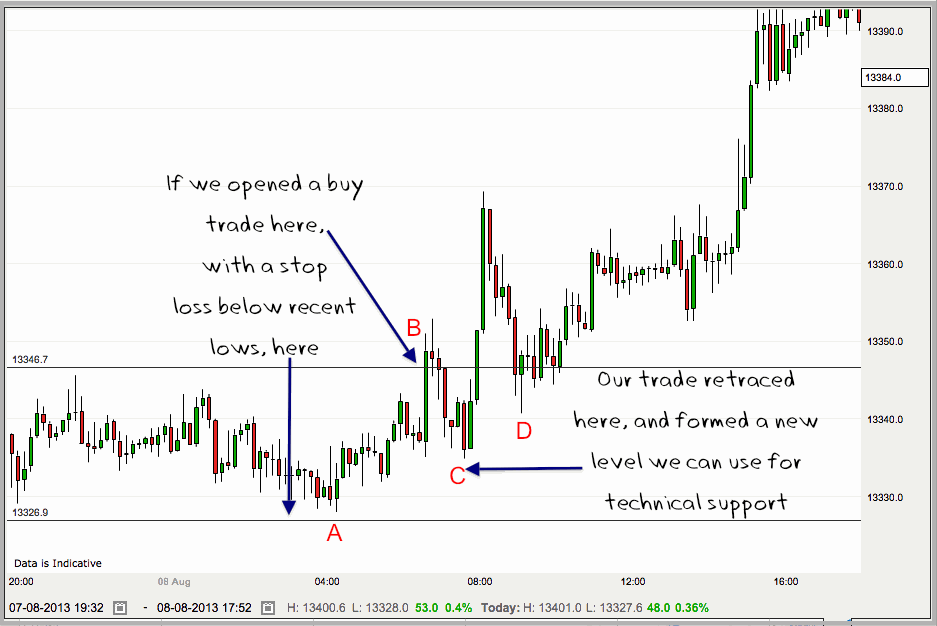
Of course, moving up stop levels does mean that you’re increasing your chances of being stopped out. But it also allows us to keep losses very tight.
There are other more-automated ways to tighten up stop levels.
You can use trailing stops, but the problem with these is their arbitrary nature – there’s no technical intelligence behind where a trailing stop will fall.
Another is using Parabolic SARs. This is a popular device for a dynamic stop level, and works like this …
Here’s a chart for the same period as above, with the points A, B, C and D still marked. However, I’ve switched up from a 10 minute timeframe to a 30 minute timeframe, and added a Parabolic SAR.
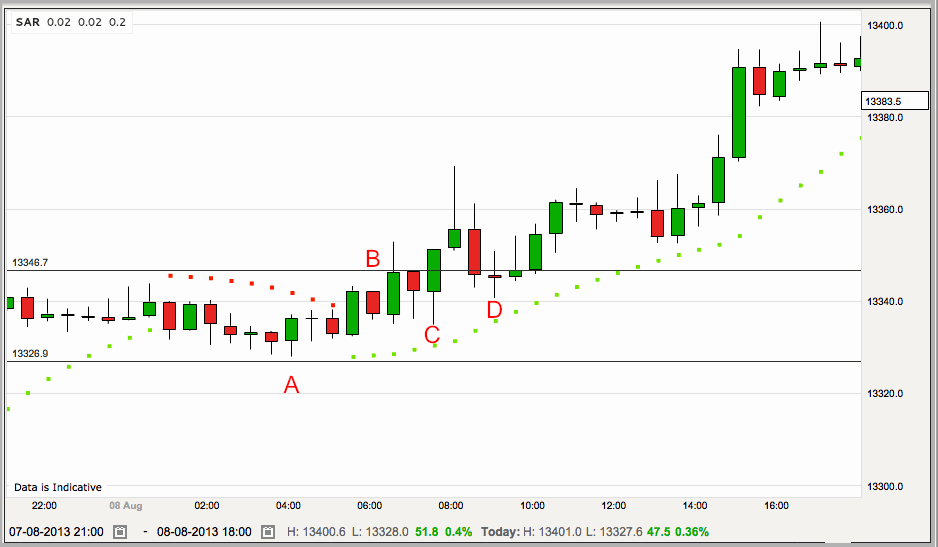
Each of those green dots represents a level of support, and can be used for dynamic support levels as your trade progresses.
Many trading strategies walk a fine line between their success rates and their risk-reward profiles. Some have a low success rate, but when it wins, it wins big. Others will have high success rates, but their occasional big losses mean that making headway is a constant battle.
The technique described above will reduce a success rate, but the improved risk-reward profile could more than make up for it.
2. Sitting out
Most regular traders I know suffer from the problem of overtrading. Which is why I feel confident telling you that you should trade less.
And when you’ve cut back on the number of trades you’re taking …
… cut back some more.
Overtrading has a very nasty side-effect – giving back profits.
If you feel that every time you make profits, you’re rapidly giving them back, this is a sign that you could be taking lots of signals, rather than focusing only on the best ones.
There are two main problems with overtrading: dilution and risk. You’re diluting your winning trades so excessively that your success rate will be moving lower and lower. Plus, all these weaker trades are exposing you to the same risk levels as the stronger signals – yet they aren’t delivering the same rewards.
It’s always worth taking a look at your trading record to see if you could be filtering out weaker signals.
As long as you keep a good trading journal, this is relatively easy to do (if you don’t, you can download the Trader’s Bulletin one here.
3. Saving on costs
This is probably the easiest and fastest fix you can make on your trading – shopping around for the best deal.
Just like your car insurance company or your bank will take advantage of you if you can’t be bothered to shop around – your broker knows that you’ve got used to how their charts look, and how their package works. They know that many of their clients can’t be bothered to look at other companies, and once they’ve got your custom, they’ll take you for granted.
Shop around for your broker, just like you would for the best insurance deal. If you can save a few points on your spread, it can make an enormous difference to the profitability of your trading.
Likewise, look at the instruments you’re trading. If you’re trading obscure currencies or pricey commodities, question why? Could you apply the same techniques to a cheaper instrument. Some of the best price moves can be picked up on the cheapest instruments like EURUSD or the Dow Jones.
Or are you holding rolling trades for days and days, incurring repeated rollover charges? This could be a big burden on your trade. If you’re going short, you really shouldn’t be paying your broker anything for a rollover – so if they’re charging you, find another broker. It’s also worth considering a futures contract, which may work out cheaper for you.
If you’re aiming to pick up 20 points profit on your trades, and you manage to save yourself 2 points in spread charges, then your trade will register a win 2 points sooner than otherwise. So you’ve just made your trades 10% more likely to win.
Each of these small changes can make the difference between a winning and a losing strategy. You don’t need a huge edge over the market to be a successful trade – you just need to keep a fraction in front, and maintain that consistently. Any one of these tiny changes could be the thing that pushes you that extra inch, into winning territory.







3 comments
Geoff Frewin
Hi Mark
A massive thanks for such an informative email as an ex Sports Coach and now a mediocre runner …I appreciated the Sports detail and relate to that still very strongly as for the technical info …brilliant yet simple , like most useful info simple but effective is best. Thanks as someone fairly new toTrading informative advice through a steep learning curve is gratefully received ! Cheers Geoff
Mark Rose
Hi Geoff, thanks for the feedback. I’m pleased that you find the post useful. I’m currently looking jealously at anyone I see running – can’t wait to get out there again! Mark
Geoff Frewin
Thanks for the response Mark, just picked it up, wishing you continued success, will follow with interest , have just received MRP looking forward to working on this and my wife is testing out Beat the Binaries with some great success at the moment . Hope you get back to full fitness soon ! Best Wishes Geoff