The time of day you trade can have a big impact on your trading success. But what’s most important is that you match your trading time to your strategy. And the market behaves very differently over each 24 hour period, offering opportunities and dangers that are unique to each session.
There are three main market sessions: Asian … London … US. And today I’m going to look at the New York (US) session, with essentials you need to remember if you want success in this timeslot.
While, it’s the last market to open each day, the New York session is a global powerhouse for trading, with market activity peaking around its overlap with the London session.
Trading on the massive US indices drive stock and currency behaviour around the world, and data announcements have global reach like no others.
To best understand trading the NY session, I think it’s helpful to break it down into chunks …
Early trading
While the opening bell rings on Wall St at 9.30am (14.30 in London), there’s a lot that goes on before this. Markets start warming up at 6.30am (11.30am in London), and that first 90 minutes offers some opportunities that are unique to this session.
As the last traders to get out of bed each day (Asian and European markets have been at it for hours by now!), New York traders will wake up with some catching up to do. And this first period will often seem an extension of what’s already been going on in European markets.
So, if London has seen bullish behaviour, we’ll often see that replicated in the early NY trading window.
However – watch out for upcoming data announcements. If there’s a big piece of news due out of the US that morning, we’ll likely see markets frozen in position, as traders wait to see which way the wind blows.
Which brings me to our next window of opportunity …
Trading the news
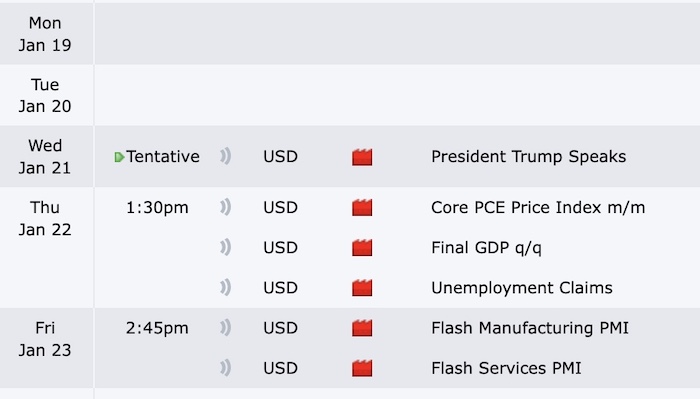
Big data announcements usually come out in the US between 8.30 and 10am (13.30–15.00 London time). A good place to check what’s coming up is www.forexfactory.com, where you can see what high-impact US events are due each week. Here’s a glimpse of next week’s …
And on the first Friday of each month, there’ll be non-farm payrolls at 8.30am (EST).
As I’ve already mentioned, ahead of these big announcements, we usually see very sluggish markets, as traders hold their breath.
In terms of trading opportunities around news … there are a lot of strategies out there for trading at these times, but I urge caution. The swings following big news have high volatility, and easily bump you out of the market, or you might struggle to get in or out of the market at the price requested. There’s a lot of opportunity for expensive mistakes.
My advice is to watch the first moves from the sidelines and then look for opportunities to enter on reactions to those moves. If you’re interested in some trading ideas around these, then let me know and I can cover it in a future post.
Trading the open
Hiding in the middle of that ‘news’ window is the actual NY opening bell. This may barely be heard if the activity from a data announcement is too loud, but that’s not everyday.
The biggest moves will often happen in that first 90 minutes of the trading day, from 8.30–10am (13.30–15.00 London time). A common pattern for this window is that the extension from the European session can continue and then correct.
Closing times
The next regular pattern of behaviour to watch out for is at the London close. The overlap between these two sessions is considerable, and the close of London will often coincide with a high/low on the US markets. As London closes, we’ll often see profit-taking from traders stateside, which sees prices retreating from the day’s extremes until the NY close.
Don’t be looking to follow moves after this time – instead we want to look for retracement opportunities.
How to make trading the NY session work for you
The NY session is exciting because there’s a lot going on … but that means that you need to have your wits about you. Data and news can be firing at you from all angles.
Take a look at some charts over the US session and see how these behaviours impact prices. Of course, these aren’t clear patterns that markets will follow each day (that would be too easy!) but they’re ‘moods’ that traders move through – and you shouldn’t underestimate the power of insight into market moods.
And if you’d like to find out about the Asian and London sessions, which have very different personalities … I’ll be covering those soon.