That was my line for many years. Every now and then I convinced myself I should try them … I lost money … I stopped using them … repeat …
Problem is that I was (along with a lot of traders who agreed with me about trailing stops) doing it all wrong.
What I want from my trailing stop
The expectation I had in my trailing stop was that I’d catch lovely big market moves and regularly see huge winners land in my account, instead of the modest number of pips I was achieving on each trade currently.
Instead of racking up 20-pips in an afternoon, I could enjoy 100- or 200-pip runs, like this …
But the reality of trailing stops can be very different
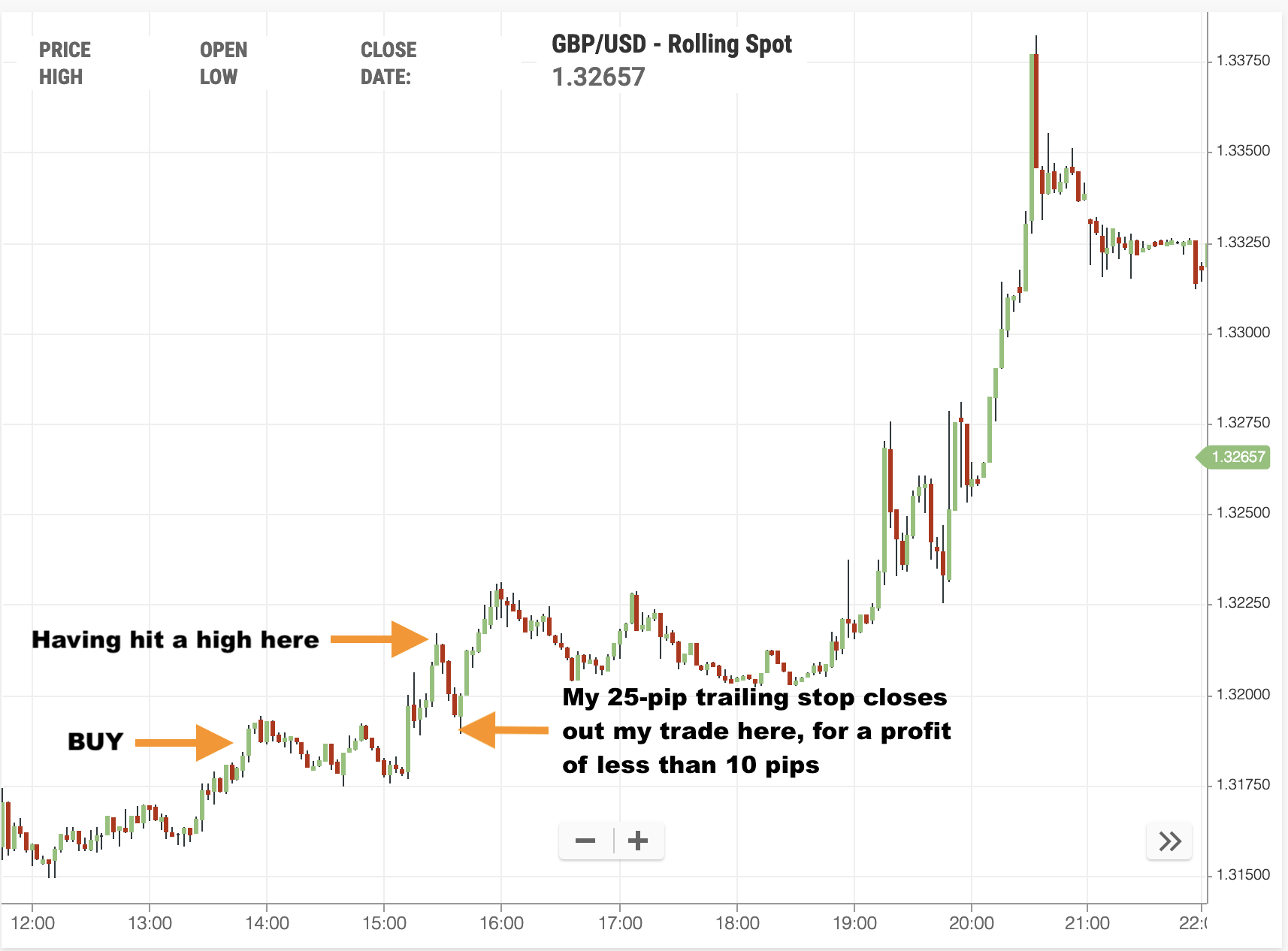
What happens instead can be more like this …
And I’ll spend the next 5 hours wishing I’d never used a trailing stop!
So, what am I doing wrong here?
The important truth to remember when using a trailing stop is that the market doesn’t normally run neatly for hundreds of pips at a time.
I’m going to repeat that …
These runs are NOT the norm.
Trailing stops will only allow us to cash in on these moves occasionally, but when they do, the moves can be really substantial, and are enough to dwarf all those dents the trailing stop has made in your profit along the way.
So, the reality of trailing stops is that they might cost us money on 90% of our trades compared to a fixed profit target. But for the few trades where the trailing stop really kicks in and works – those profits will be big enough to make a significant difference to our profits.
But most traders (I include myself in that) don’t give trailing stops a chance to prove themselves because we’ve got frustrated with those reduced profits and given up too early.
So, the first thing we’re getting wrong with trailing stops is our expectations. Most of our trades will make LESS money with a trailing stop, but we can expect occasional BIG winners.
Now let’s look at how we can get the parameters right for the trailing stop
The easiest way to apply a trailing stop is to allow your broker to manage it for you – just click the ‘trailing’ button on your trade ticket, and your broker will automatically trail your stop for you ‘X’ pips behind the price.
Sometimes this is the only way to do it – if you don’t have the time to manage it yourself (although using MT4 programming can help here).
However, if you’re able, a better way to run trailing stops is to adjust them according to what the market is doing. Here are some of the best ways …
1 • Moving averages
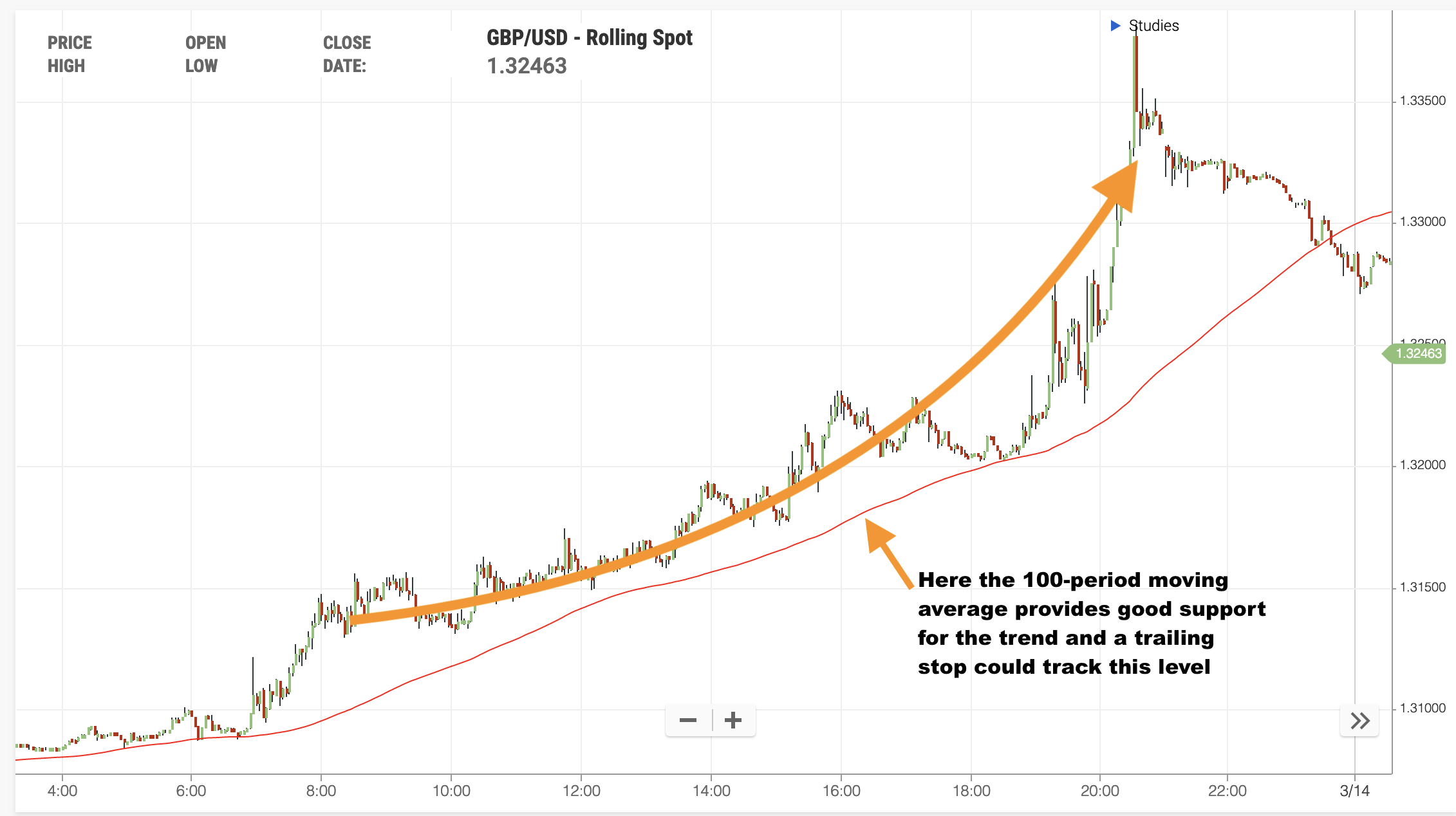
Significant moving averages levels (like 20MA, 50MA or 100MA) often give support for trends, with prices bouncing off them. For this reason, one of these levels can make a really useful trailing stop, with the stop level being adjusted at regular intervals in-line with the moving average level.
In the example here, the 100-period simple moving average supports the trend, and could be used for trailing stop levels …
The tighter the moving average (i.e. the lower its number of periods), the tighter your trailing stop will be.
2 • Parabolic SAR
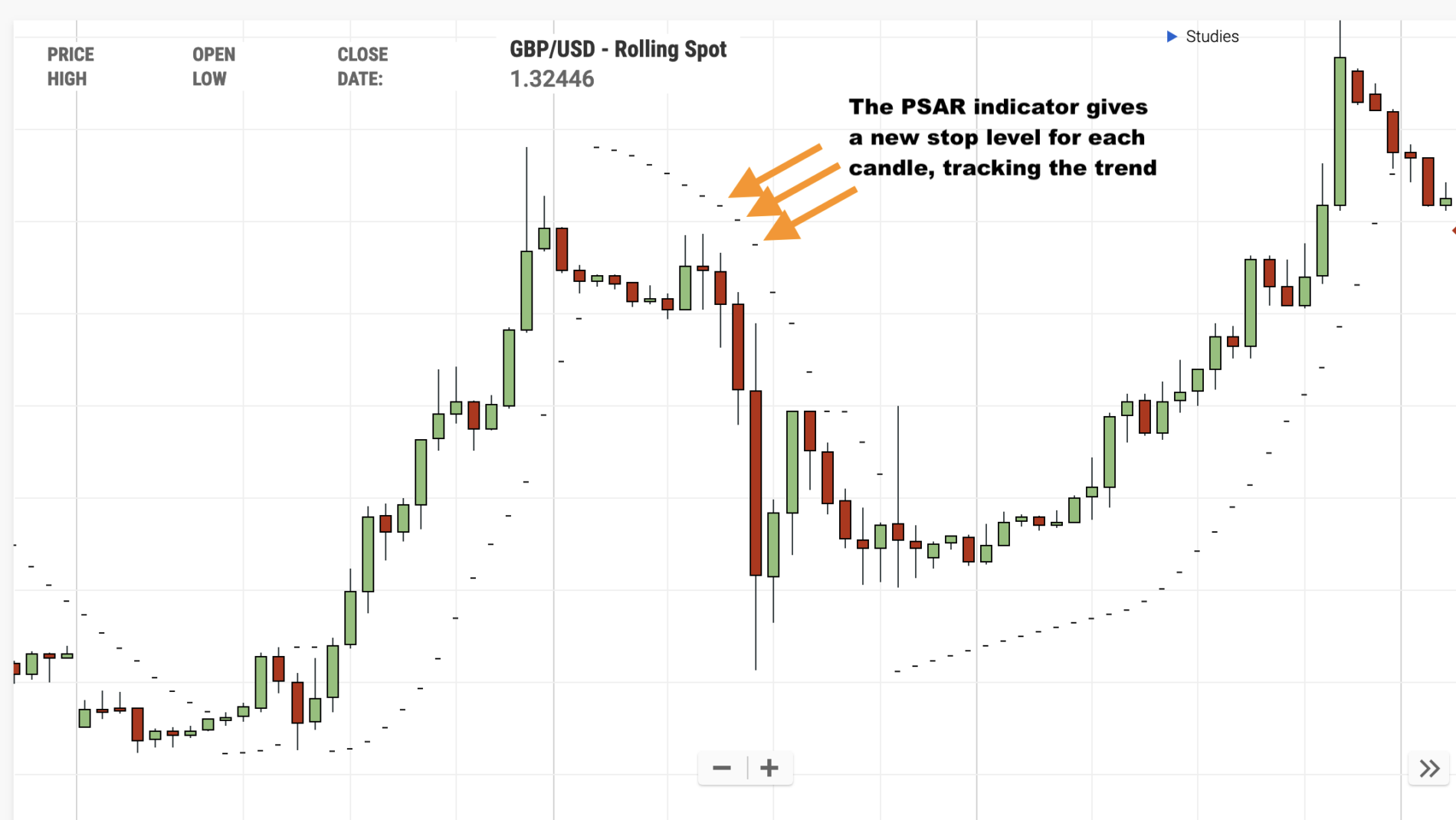
The Parabolic SAR (or PSAR) is a popular trailing stop tool. It gives us a series of levels on our charts which track the price and make useful trailing stop price levels.
3 • Recent swings
As we know all too well, prices don’t move in neat straight lines, but we can use those annoying pullbacks to our advantage and recognize them as new levels of support or resistance for the trend we’re trading.
In this example, a series of lower highs show us fresh resistance for our trend – and the perfect positioning for a trailing stop.
Picking these levels does have some subjectivity to it. It’s easy to see these neat bumps in retrospect, but as they are forming on our charts it’s more tricky and takes some practice.
(If you’d like a simple tool that acts a bit like a swing indicator – take a look at the Donchian channel. There’s more info on this indicator here.)
The final technical tool for trailing stops is one that can be set up on your trading ticket at the start, and left alone (assuming your broker offers a trailing-stop facility) …
4 • Average True Range
The average true range on a chart is a handy measure of the size we can expect future candlesticks to be. The indicator looks at the previous ‘X’ number of candles (14 periods is the default setting), adds up range of each candle (including any gaps if the price has jumped between candles), and divides that by 14 to give us an idea of what move we can expect from a candle.
It’s a good way to get a picture of the volatility in a market, and traders who trail stops can use this information to set a stop distance.
Depending on how long you expect your trade to run, you’ll choose a multiple of the ATR value for your trailing stop, so it might be 2 x ATR … 3 x ATR … 4 x ATR … etc.
In this example, the ATR when the trade was placed was 4 pips, and we’re using a 4 x ATR multiple for the trailing stop.
As you can see, setting a trailing stop at the start of a trade, and leaving that to run on its own is a more clunky solution, and doesn’t adapt to market conditions as well. However, it’s a lot simpler and takes less effort for the trader (and there’s less margin for error).
I haven’t covered my favourite technical trailing stop here – it’s the one I use in Heikin Ashi Mountain – members will know how this works already. If you’re not a member – the clue is in the name!
But another issue we haven’t covered is how we deal with the discomfort of a trailing stop – the repeated dents in our profits when the price pulls back, while we’re waiting for the big winners …
How can we make peace with the trailing stop?
We could just use a stiff upper lip to suffer the pain, but here are two better ways …
Taking partial profits
By pocketing some profits along the way and leaving just half of our trade to continue running to our trailing stop, we can cash in on a profit achieved, even if the price then reverses and our trailing stop is taken out.
Long term, this method may not make as much money as holding out for 100% of the big moves, but it’s likely to give us a smoother profit curve – good for our sanity and our compound investing.
Adding a profit target
Okay, so the whole point of a trailing stop is that we’re giving the market room to run, so our positive return on a trade isn’t limited … but it IS possible to add a profit target.
Any target should be ambitious though.
Including a target is especially important if you’re managing the trailing stop manually – it’s very frustrating if the price spikes up and you’ve not had time to adjust your stop before it’s reversed.
Putting it together
Lots of these ideas can be combined.
For example, you can use a basic broker-run trailing stop that’s quite wide, and manually adjust it where you see new levels form (and have the time to check on your trades).
You can always include a profit target, and still run your stops up to it.
And any strategy can be combined with partial profit-taking.
If you’ve found a method that works for you with trailing stops, please share in the comments section below.