March 1, 2013by Mark Rose- 0 comments
Trading – just like mama used to make
Over half term I took my kids to the science museum, where they spent a good deal of time looking in tubes, turning handles and flicking switches.
I’m not sure what they learned from the day (other than to fleece their dad in the gift shop on the way out), but I came home with one good fact: that the Apollo computer that put man on the moon had the operating power of a pocket calculator.
It felt impressive that they’d put their life in the hands of something so modest. But then, these were the days when, back at NASA, they were still using slide rules.
While I wouldn’t even dare to walk to the postbox at the end of the road without the 1GHz of my mobile phone tucked in my back pocket, I’m learning that the speed and power come to expect around us in the modern world aren’t always the best way of doing things.
Don’t worry, I’m not about to throw out the telly and go self-sufficient.
I’m talking about high-speed internet connections giving us instant access to every twist and turn of price action …
… how useful is it really?
Has it made us richer as traders?
Or just make brokers richer in commissions?
A few weeks back I talked about the benefits of taking our trading decisions more slowly by following longer timeframes. And about how this style of trade, over the medium- to long-term, proved (in general) to be more profitable than day trading.
Well, for the past two years, I’ve been working with just this kind of old-school investor – who looks for really solid long-term technical signals, makes his move, and then waits for the markets to deliver.
He’s not someone with a flashy background in the City, or who’s been bragging about his achievements across the internet – he’s just an old-fashioned guy who’s been quietly hauling in steady profits for himself and his clients for years.
I’m sure he won’t mind me telling you that he’s no spring chicken – this guy was trading the markets back when my idea of trading involved football cards.
And I have found his methods to be truly inspirational.
Occasionally his trades pay out in the space of a few days, but usually it’s a number of weeks, even months. It’s the way serious money has been made from the markets for years (before we all had our heads turned by the excitement of high-speed trading).
Over the next few weeks, I’m very excited to be introducing you to this market veteran – who has agreed, for the first time (and after two years of pestering from me!) to share his trading methods.
Please keep an eye out for much more about this.
In the meantime, I’d like to take a look at a very long-term signal that’s got traders hot under the collar this week.
Long-term warning signs …
I’m talking about the death crosses on gold and silver.
A death cross occurs when a 50-day moving average crosses below a 200-day moving average.
In trading terms, it’s the equivalent to answering the front door to find a man dressed in a black hooded cloak carrying a scythe. Not good news.

- Death Cross on Gold Chart
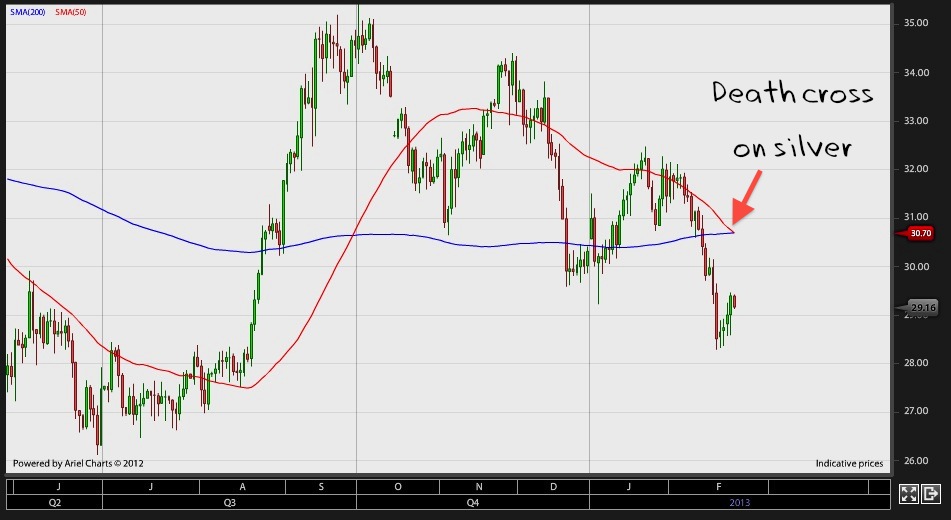
- Death Cross on Silver Chart
Death crosses (and their opposite, “golden crosses”) don’t come along very often – maybe once or twice a year. So they tend to get a fair bit of attention.
But just how reliable are they?
If you question the validity of a death cross, people will usually drag out the example of the death cross on the FTSE of Autumn 2007, as the markets crashed.
However, if you just take a glance at the charts above, we can see a death cross on gold at the beginning of 2012, slap bang in the middle of a bull run. And a golden cross on silver just as the market peaked.
While I firmly believe that a long-term moving average is a fantastic technical tool – we have to understand its limitations. Moving averages are lagging … and longer-term moving averages lag more. So, if we’ve markets that are choppy, then a long-term moving average is going to struggle. And it’s why technical traders tend to use a combination of signals.
While a death cross doesn’t tell us that the market will crash, it does tell us to be cautious. And beware of listening to the pundits. There’s no shortage of opinion on why gold must go up or down, but many of these people are heavily invested in metals, making it difficult for them to give impartial advice.
And please don’t forget to watch out for my message next week, when I want to show you a long-term signal that really does work …